
ESD/EOS classification limits (ANSI/ESDA/JDEC JS-001and JS-002) apply to the risk of component damage during the handling and assembly processes involved in manufacturing electronic systems.
Once these systems are connected to the outside world, a different set of standards, the IEC 61000 series, applies. The IEC 6100 series of standards envisions much more severe EOS events than component-level classification levels, and a component’s ESD rating is not a guarantee that it can survive when unprotected from more severe events like switching noise in a factory or a nearby lightning strike.
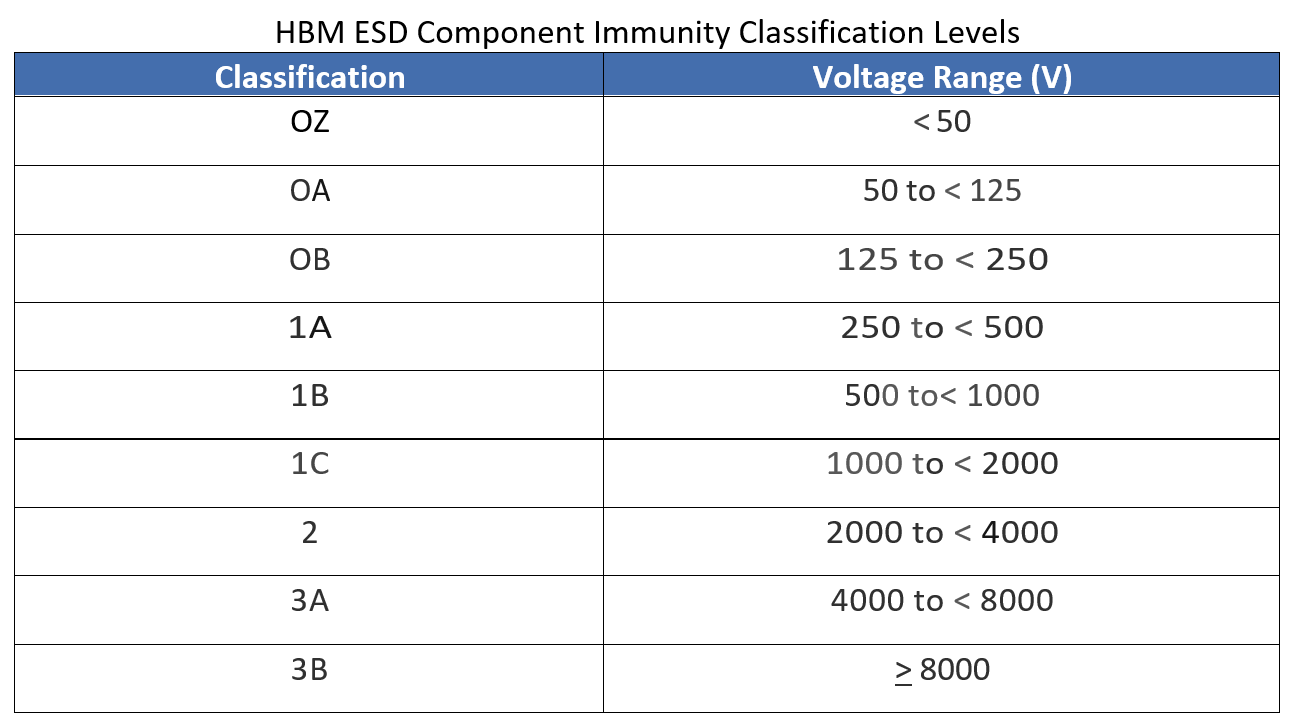
Human Body Model. One model for characterizing the ESD threshold of an electrical component is the Human Body Model (HBM). The human body is an effective conductor of electricity; we generate static through many common activities. The HBM (defined in ANSI/ESDA/JDEC Joint Standard for Electrostatic Discharge Sensitivity Testing JS-001) is a mathematical representation of what occurs when a charged person contacts an uncharged part or vice versa. The HBM representation is based on an equivalent circuit with a charged 100-pF (picofarad) capacitor in series with a 1500 Ω (ohm) resistor. Component HBM Immunity Classification levels are shown in the table below.
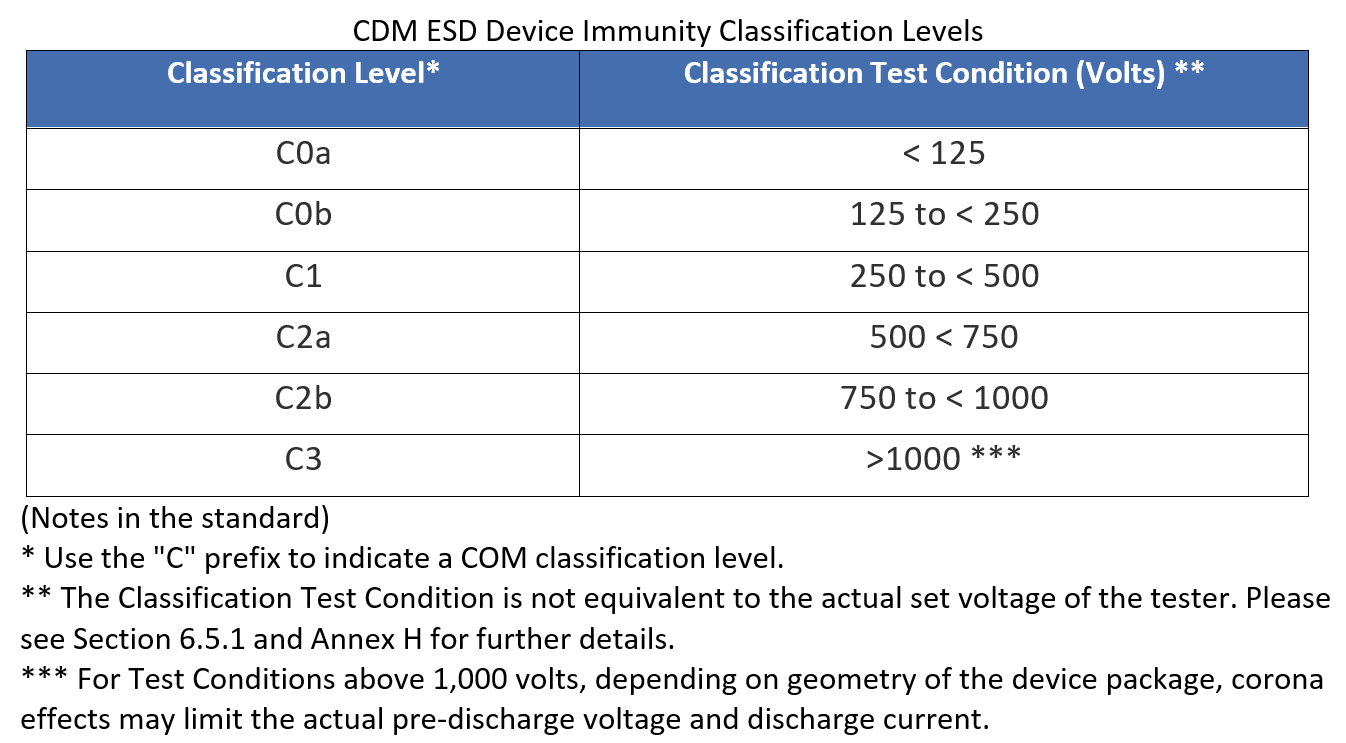
Charged Device Model. Another model for characterizing the ESD threshold of an electrical component is the Component-Level Charged Device Model (CDM). The CDM is a mathematical representation of a differential charge event between a component and any non- human object charged by triboelectricity or static induction. With the increased use of automation in manufacturing, machines that develop static charges which are not properly grounded can induce charges in nearby devices, which eventually discharge on contact with a conductor. Contact resistances are typically low in these instances, thus large, extremely short, short-duration currents can occur, for example e.g., 10 Amps for 1-2 nanoseconds. CDM currents are higher than HBM currents because there is no current limiting resistor in the path to limit the discharge. Threshold voltages for CDM (shown in the table below) are lower than HBM due to these higher currents.
To learn more about LED electrical stress and how to prevent damage to LEDs, read the Luminus Application Note: Electrical Stress Damage to LEDs and How to Prevent It
------------------------------------------------------------------------------------------------------------------
Luminus Website https://www.luminus.com/
Luminus Product Information (datasheets): https://www.luminus.com/products
Luminus Design Support (ray files, calculators, ecosystem items: [power supplies, lenses, heatsinks]): https://www.luminus.com/resources
Luminus Product Information sorted by Applications: https://www.luminus.com/applications
Where to buy Samples of Luminus LEDs: https://www.luminus.com/contact/wheretobuy.
--------------------------------------------------------------------------------------------------------------------
Technical Support Contact Information: techsupport@luminus.com
Sales Support Contact Information: sales@luminus.com
Customer Service Support Contact Information: cs@luminus.com
Comments
0 comments
Please sign in to leave a comment.